

Paying for college in the United States is one of the biggest concerns for students and their families. Tuition, room and board, textbooks, and living expenses can quickly add up. Fortunately, the federal government and many universities provide financial aid to help make college more affordable. Understanding FAFSA and the broader financial aid process is the first step toward reducing costs and maximizing available funding.
This guide will explain everything students need to know about FAFSA, how financial aid works, types of aid, and strategies to get the most support for college expenses.
What is FAFSA?
FAFSA stands for Free Application for Federal Student Aid. It is the primary application used to determine a student’s eligibility for federal financial aid programs, including grants, loans, and work-study opportunities. FAFSA is required by most colleges and universities in the USA to consider students for need-based financial aid.
FAFSA collects information about a student’s and family’s financial situation, including income, assets, and household size. The federal government and schools use this information to calculate the Expected Family Contribution (EFC), which determines how much financial aid a student can receive.
Filling out FAFSA accurately and on time is critical for maximizing financial aid opportunities.
Why FAFSA Matters
FAFSA is the gateway to financial aid, and submitting it early can make a major difference. Students who complete FAFSA can qualify for:
- Federal grants such as the Pell Grant, which do not need to be repaid.
- Federal student loans with lower interest rates and flexible repayment options.
- Federal work-study programs that provide part-time employment opportunities on or near campus.
- State grants and scholarships, many of which require FAFSA for eligibility.
- Institutional aid from universities, which often relies on FAFSA data to award need-based scholarships.
Even if you think you may not qualify for need-based aid, submitting FAFSA is still recommended because some schools use it to determine eligibility for merit-based awards as well.
When and How to Apply
FAFSA applications typically open October 1 for the following academic year. It is important to submit as early as possible because some financial aid is awarded on a first-come, first-served basis.
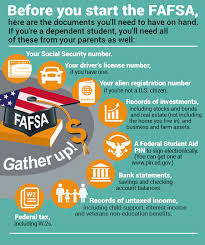
Students can apply online through the official FAFSA website. The application requires:
- Social Security number or Alien Registration number for non-citizens.
- Federal income tax returns and W-2 forms for students and parents.
- Records of untaxed income and assets, such as savings and investments.
Many families find it helpful to gather all financial documents before starting the application to ensure accuracy. Mistakes or missing information can delay processing.
Understanding the Expected Family Contribution (EFC)
After submitting FAFSA, the federal government calculates the Expected Family Contribution (EFC). This is an estimate of how much your family can contribute toward college costs. The lower the EFC, the higher the potential financial aid award.
The EFC is not the amount you will pay directly to the school. Rather, it is a tool that colleges use to design a financial aid package that covers the gap between your family contribution and the total cost of attendance.
Types of Financial Aid
Financial aid in the USA comes in several forms, and understanding each type is key to making informed decisions:
1. Grants – Grants are funds that do not need to be repaid. The Pell Grant is the most common federal grant, but states and individual colleges may offer additional grants.
2. Scholarships – Scholarships are awarded based on merit, talent, or specific criteria such as community service or intended major. Some scholarships are competitive, while others may be automatically awarded based on FAFSA or school applications.
3. Work-Study Programs – These programs allow students to work part-time while attending school. Earnings from work-study help cover living expenses and reduce the need for loans.
4. Federal Student Loans – Loans must be repaid, but federal student loans often have lower interest rates, flexible repayment plans, and deferment options compared to private loans.
5. State and Institutional Aid – Many states and universities offer additional need-based or merit-based aid. FAFSA is frequently required to qualify for these programs.
How to Maximize Your Financial Aid
To make the most of financial aid opportunities, consider these strategies:
- Submit FAFSA early – Applying as soon as possible increases your chances of receiving limited funds.
- Apply to multiple schools – Compare financial aid packages from different universities to find the best value.
- Research scholarships – Look for both local and national scholarship opportunities. Many have unique eligibility criteria that can give you an advantage.
- Keep your information accurate – Avoid errors in income, tax, or asset reporting, as mistakes can reduce aid eligibility.
- Reapply each year – Financial aid eligibility can change annually, so completing FAFSA each year is necessary to maintain funding.
Common FAFSA Mistakes to Avoid
Many students make simple mistakes that delay or reduce aid:
- Missing deadlines.
- Providing incorrect Social Security numbers or tax information.
- Forgetting to include income or asset information.
- Failing to sign the FAFSA electronically using a FAFSA ID.
- Assuming aid is guaranteed; your eligibility depends on accurate and complete submission.
Double-checking all entries and submitting early can prevent most issues.
Beyond FAFSA: Additional Financial Planning
While FAFSA covers most federal aid, families should also explore additional resources:
- State grants – Many states offer programs for in-state students.
- Institutional aid – Colleges may have endowments for need-based or merit-based awards.
- Private scholarships and foundations – Numerous private organizations support students in specific fields or with unique backgrounds.
- Payment plans and budgeting – Many universities offer monthly payment plans to spread tuition costs over time.
By combining these strategies, families can reduce out-of-pocket costs and minimize student loan debt.